
Picture Real Madrid. One of the most recognised sports clubs in the world, worth billions. Now imagine walking into a bank and asking for a loan with that as collateral. You would expect a generous yes, right?
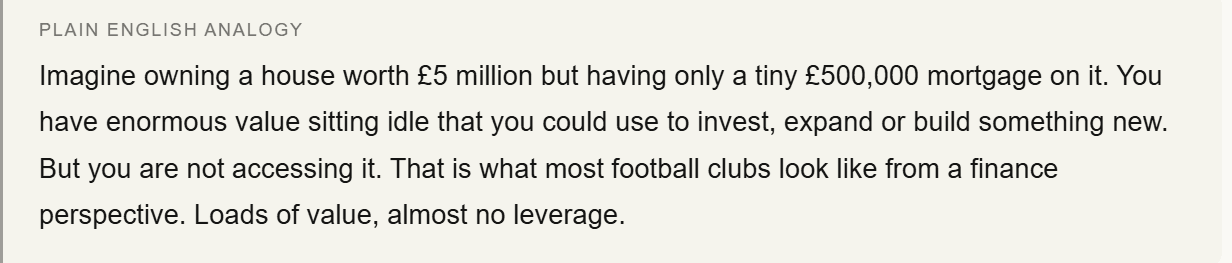
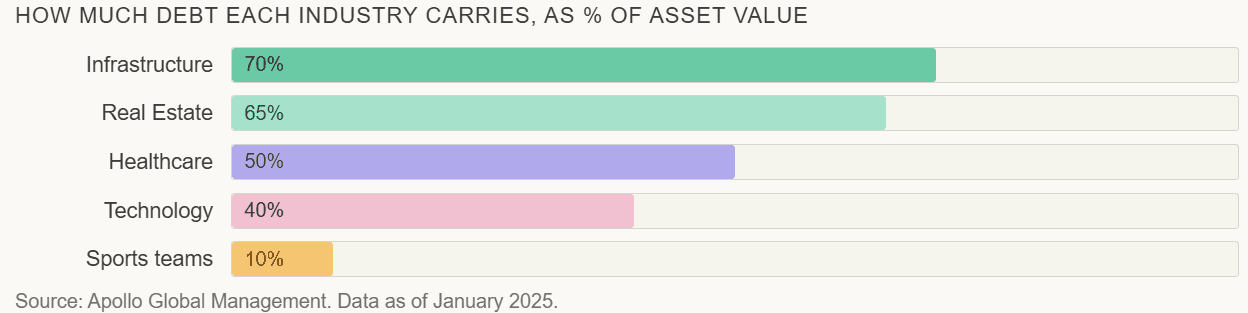
Surprisingly, most sports teams carry almost no debt. On average, professional franchises are financed at just 10% of their value. That means a $10 billion club might have only $1 billion in loans against it. Compare that to a shopping mall or office building, which routinely borrows against 50 to 70% of its value, and you start to see the gap.
That gap is what Apollo Global Management, one of the world's largest investment firms, is calling "the financing gap in sports." They believe it represents a $2.5 trillion opportunity hiding in plain sight.
Sports is not just a game anymore. It is a massive business.
Think about how you watch football today compared to 30 years ago. Back then, you bought a ticket or watched on TV. That was basically it. Today, a top club earns money from live broadcasts, streaming platforms, social media sponsorships, merchandise sold in Tokyo, video game licensing, fitness apps, stadium concerts, and even real estate.
The numbers are staggering. The global sports media rights market alone crossed $60 billion in 2024. The Premier League's latest TV deals are worth billions, and UEFA Champions League rights continue to climb every cycle. For context, the amount top football leagues earn from broadcasters rivals what Netflix spends on all its content globally. And Netflix makes TV shows for 300 million people around the world.

And here is the thing about sports that makes it different from, say, a tech startup: it almost never fails. During the COVID-19 pandemic, sports revenues collapsed virtually overnight. Stadiums went dark and seasons were cancelled. Yet not a single major club went under. Values recovered quickly and kept climbing. That kind of resilience is genuinely rare.
Why Sports Is Special
The one thing Netflix, TikTok and YouTube cannot kill
We live in a world of infinite entertainment on demand. You can watch anything, anytime, anywhere. That has been devastating for traditional TV, movies and music. But there is one thing streaming has not been able to kill: live sport.
When your team is playing, you have to watch now. You cannot save it for later. The whole point is the shared, real time experience. That makes live sport the most valuable content in media. The 10 most watched television broadcasts in US history are all Super Bowls. In the UK, the most watched programme ever is the 1966 FIFA World Cup Final, still ahead of royal events
Fan loyalty also works differently in sport. When someone supports Manchester United or Barcelona, that loyalty often lasts a lifetime and gets passed to their children. Season ticket waiting lists at clubs like Arsenal and Borussia Dortmund run into tens of thousands of names. Some fans wait decades to get theirs. Try getting that kind of loyalty from a streaming service.
Apollo's research found that franchise values have grown at around 13% per year for six decades, beating the stock market at 10.5%, a typical investment portfolio at 9%, gold at 6.7% and bonds at 5.8%. All of that while being largely immune to economic downturns.
The Money Side
So why are banks not lining up to lend to football clubs?
This is where it gets interesting. You have an asset class that has been growing at 13% a year, never defaults, has loyal supporters who literally pass down their fandom to their children, and is backed by massive TV contracts. Sounds like a dream borrower, right?
Yet banks have historically treated sports as niche and hard to value. Leagues had strict rules about who could own clubs. For a long time, private investment funds were largely kept out of major football ownership structures. That meant no institutional money, no sophisticated financing, no optimised capital structures. Just wealthy individuals buying clubs and holding them as passion assets.
The chart below shows how extreme this gap is. Most major industries borrow against 40 to 70% of their assets. Sports teams sit at around 10%.
What Is Changing
The rules are changing and big money is taking notice
The pandemic cracked the old model open. When matchday revenues vanished overnight in 2020, even the richest club owners had a cash flow problem. Leagues that had long resisted outside capital suddenly needed it. And slowly, the gates began to open.
European football actually led the charge. Private equity investment across Europe's top five football leagues surged from €66 million in 2018 to €10.6 billion in 2023. Clubs in England, Spain, Italy, France and Germany began welcoming institutional investors who could bring not just money but also commercial expertise and global networks.
What changed in football
Private equity firms are now buying minority stakes in clubs across Europe and beyond. They bring capital for stadium upgrades, youth academies and global commercial expansion, without taking over day to day management.
What this means for fans
More capital flowing in means more investment in stadiums, technology, player development and fan experience. Think better apps, smarter venues and more global content.
European football led the way
PE investment in Europe's top five football leagues jumped from €66 million in 2018 to €10.6 billion in 2023. Football was the first major sport to embrace this shift at scale.
Other sports joining in
Pickleball, women's basketball, UFC and Formula 1 are all attracting institutional money. Women's sports alone are projected to generate $2.4 billion in revenue in 2025.
What It All Means
Will AI disrupt sport too? Probably not in the way you think.
AI is reshaping almost every industry. But Apollo argues that sport is one of the few sectors that is actually protected from it. No algorithm can replicate the feeling of watching your team score in the dying minutes of a match. No chatbot can recreate the atmosphere of a packed stadium. The core product is elite human competition in real time, and that is something technology genuinely cannot automate.
In fact, AI might make sport more valuable. As people work more efficiently thanks to AI tools, they will have more free time. More free time means more demand for live entertainment. Football, with its appointment viewing nature, is perfectly placed to capture that attention.
The bottom line
Sports franchises are highly valuable, emotionally sticky, cash generative and almost never fail. They are just wildly under financed relative to their worth. And that gap is finally starting to close.
For everyday fans, this shift might seem distant. But the influx of institutional capital into sport will shape what the next generation of fan experience looks like, from the stadiums you sit in, to the apps you use, to which clubs can afford the best players. The business of sport is entering a new era. And like the best moments on the pitch, it is probably going to be worth watching.